

The New Heirloom: Why the Detachable Embroidered Collar Is Fashion's Most Quietly Radical Accessory
From Cardinal Richelieu's court to a Ukrainian family's atelier in Bucha — how a hand-cut linen collar became the season's smartest way to wear heritage on your shoulders
- The detachable embroidered collar is the most elegant heritage investment of the season — and at Blouse Roumaine Shop the definitive versions are worked in Richelieu cutwork and point lace, entirely by hand in 100% linen, by the Ukrainian family brand ANNABO.
- These two centuries-old techniques are opposites that meet on one collar: Richelieu cutwork begins with woven linen and cuts it away, suspending the motifs on hand-worked bars (brides); point lace builds openwork from a single thread and needle, with no ground cloth at all.
- Rooted in Ukraine's own "white-on-white" whitework heritage, the collar moves from sweater to coat to strapless dress — a genuine new heirloom rather than a passing trend.
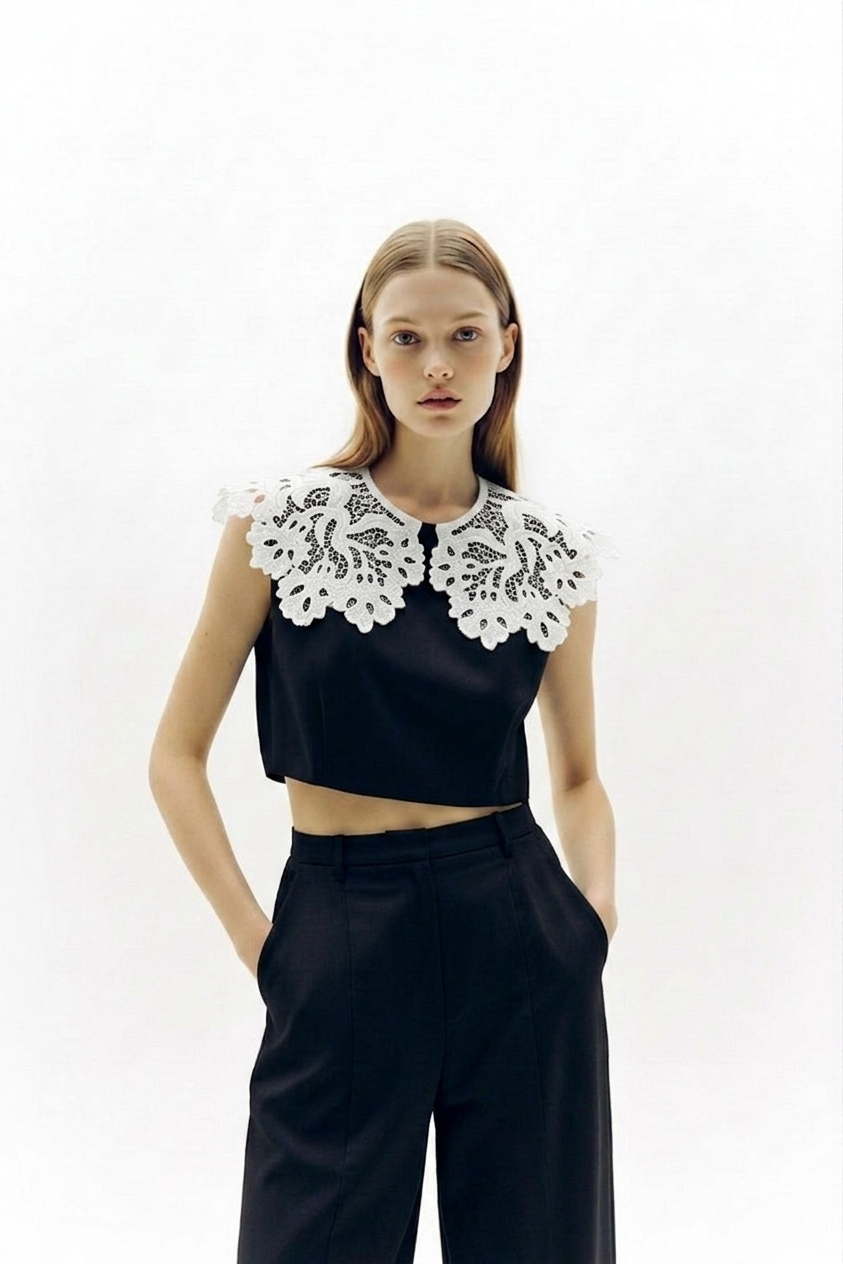
There are accessories that shout, and there are accessories that whisper — and it is almost always the whisper we remember. The detachable embroidered collar belongs firmly to the latter camp: a slip of hand-worked linen that transforms a plain sweater into an occasion, a tailored coat into a statement, a white shirt into an heirloom. This season, at Blouse Roumaine Shop, that whisper is worked in Richelieu cutwork and point lace by the Ukrainian artisan family behind ANNABO — and it may be the most elegant investment you make all year.
Key Findings
- The craft is authentic and rare. ANNABO's collars are hand-cut and hand-stitched in linen, made to order over one to four weeks, by a family atelier in Bucha, Ukraine — not machine-made costume pieces.
- Two techniques, one collar. Richelieu cutwork (subtracting fabric) and point lace (building fabric from thread) share a common ancestry in the buttonhole stitch and the connecting bride, which is precisely why they harmonise on a single piece.
- Deep cultural roots. The embroidered neckline is the most meaning-laden part of both Romanian and Ukrainian folk dress; the collar liberates that ornament to travel across a modern wardrobe.
- A trend with staying power. The statement collar has cycled through the runways since 2019, but ANNABO's heritage versions transcend the trend cycle — they are designed to be kept, not replaced.
The embroidered collar, then, is not a novelty. It is a fragment of that deeper grammar — the part of the garment that always carried the most meaning, now freed to travel from piece to piece across a modern wardrobe.
The Ingenious History of the Detachable Collar
The idea of a collar that comes off is itself a small revolution. Per New York Almanack, "the first detachable collar" was "crafted in 1827 at 139 3rd Street in Troy, NY," by Hannah Lord Montague (1794–1878) — a woman tired of laundering her husband's entire shirt when only the neckband was soiled. She snipped the collar off and re-attached it with "lengths of fabric tape"; Rev. Ebenezer Brown commercialised the idea in 1829 (Wikipedia, "Detachable collar").
Her ingenuity turned Troy into "Collar City" and eventually gave us the phrase "white-collar worker."
What began as domestic practicality became, by the Victorian and Edwardian eras, a canvas for self-expression. Women layered elaborate lace berthas and starched linen collars over their gowns, refreshing an entire look without owning a second dress. The Gibson Girl's high lace collar was pure architecture.

Today, the collar has staged its own comeback. It reappeared on the runways at Simone Rocha and Self-Portrait around 2019, was reinterpreted by Ganni's cult poplin styles, and has continued to evolve through Gucci and beyond. What makes the independent designers such as Foberini or ANNABO collars different is that they are not costume references. They are the real thing: heritage craft, made by hand, made to keep.
The Family Behind the Thread: ANNABO
Some brands invent a heritage. ANNABO inherited one.
Founded in 2018 in Ukraine, ANNABO is a genuine family enterprise. Natalia — the mother — designs and creates the collections; Boris — the father — manages operations and the technical craft; and Anna — the daughter — leads the brand's storytelling from Chicago. Their story begins earlier, in 2000, with a tailoring and machine-embroidery company; the leap into their own artisanal label came in 2018, after Natalia studied at a fashion school in Paris and joined the Ukrainian Designers Association.

The soul of the brand is literally an inheritance: Natalia's own mother was an embroiderer, and Boris's grandmother left the family a wooden chest filled with embroidered treasures from the last century — the vintage motifs that still inform ANNABO's work today.
Their resilience is part of the story, too. ANNABO's workshop sits in Bucha. After the full-scale invasion in 2022, the family resumed production in May of that year, later showing their collections in Turin and at Milan Fashion Week. Every collar you tie around your neck is, in a quiet way, an act of cultural continuity.
The Techniques: Richelieu Cutwork and Point Lace, Explained
The magic of these collars lives in two intertwined techniques — both worked entirely by hand, both centuries old.
Richelieu Cutwork: Drawing With Absence
Richelieu is a form of whitework cutwork. The technique traces, per Wikipedia (Cutwork) and Ancient Origins, to when "cutwork… appeared in Europe, perhaps in the 14th century AD… The roots of this decorating style are in Italy," where it was known as punto tagliato — literally "cut point," and "considered the precursor of lace." It later took the name of Cardinal Armand Jean du Plessis, Cardinal de Richelieu (1585–1642), chief minister to King Louis XIII of France, who prized it. (The Metropolitan Museum of Art holds a French "Standing Band (Collar) with Tassels, c. 1610–20" in cutwork and needle lace — proof that these techniques adorned detachable collars four centuries ago.)

The method is a beautiful paradox: the artisan creates the design not only by adding thread but by removing fabric. As the Embroiderers' Guild of America describes it, verbatim: "Embroiderers work design outlines in buttonhole stitch; with the fabric thus reinforced, they then cut away sections of the fabric. Bars, or 'brides' create connections between the open areas." Those slender bars hold the composition together and become part of the pattern itself. The result is a lace-like play of solid and void, light and shadow, worked traditionally on fine linen.

Every ANNABO collar carries this DNA: the ground cut away, the motifs suspended on hand-worked bars, the whole thing as much drawing as textile.
Point Lace: Building Fabric From Thread Alone
If Richelieu subtracts, point lace adds from nothing. Point lace — a form of needle lace — is a single-thread technique in which the lace is built up entirely with the needle, stitch upon stitch, until a fabric appears where there was none. The stitches, most often buttonhole stitches, are worked on a couched outline (a cordonnet) and do not pierce any ground cloth. Historically, needle lace developed directly from cutwork — which is why the two techniques sit so naturally together on a single collar.
The distinction is the heart of the craft: Richelieu begins with woven linen and cuts it back; point lace conjures its openwork purely from thread. On these collars, the two meet — the cut ground of Richelieu resolving into the airy, needle-built passages of point lace.

The Ukrainian Whitework Lineage
This is not merely a French borrowing. Ukraine has its own profound cutwork tradition — called vyrizuvannia — worked predominantly in white or unbleached thread. The most celebrated expression is the "white-on-white" embroidery of Reshetylivka in the Poltava region, which (per Wikipedia's Reshetylivka embroidery entry) combines "up to 5–7 different techniques in one product" and can take from two to six months to complete a single garment; one of the oldest surviving examples is "a Chernihiv towel from 1746." It was added to Ukraine's National Inventory of Intangible Cultural Heritage (2017–2018), and — per recent nomination documents — was put forward for the UNESCO Representative List. When ANNABO works Richelieu and point lace, it draws on a living national heritage, not a museum artefact.

Three to Cherish: The Featured Collars
Curated from the Collars collection at Blouse Roumaine Shop, each of these is made by hand in 100% linen, made to order, by ANNABO in Ukraine.
1. Lily Richelieu Embroidered Cutwork Collar — White Linen
The purist's choice. White embroidery on white linen, cut in a soft rounded silhouette that sits gracefully over a blouse, a dress, or a coat and redraws the line of each. This is the collar that turns a cashmere crewneck into something a museum curator would covet — tonal, architectural, endlessly wearable. 100% linen · Richelieu cutwork, point lace · white on white · Shop now →
2. Barvy Richelieu Embroidered Cutwork Collar — Black & Silver
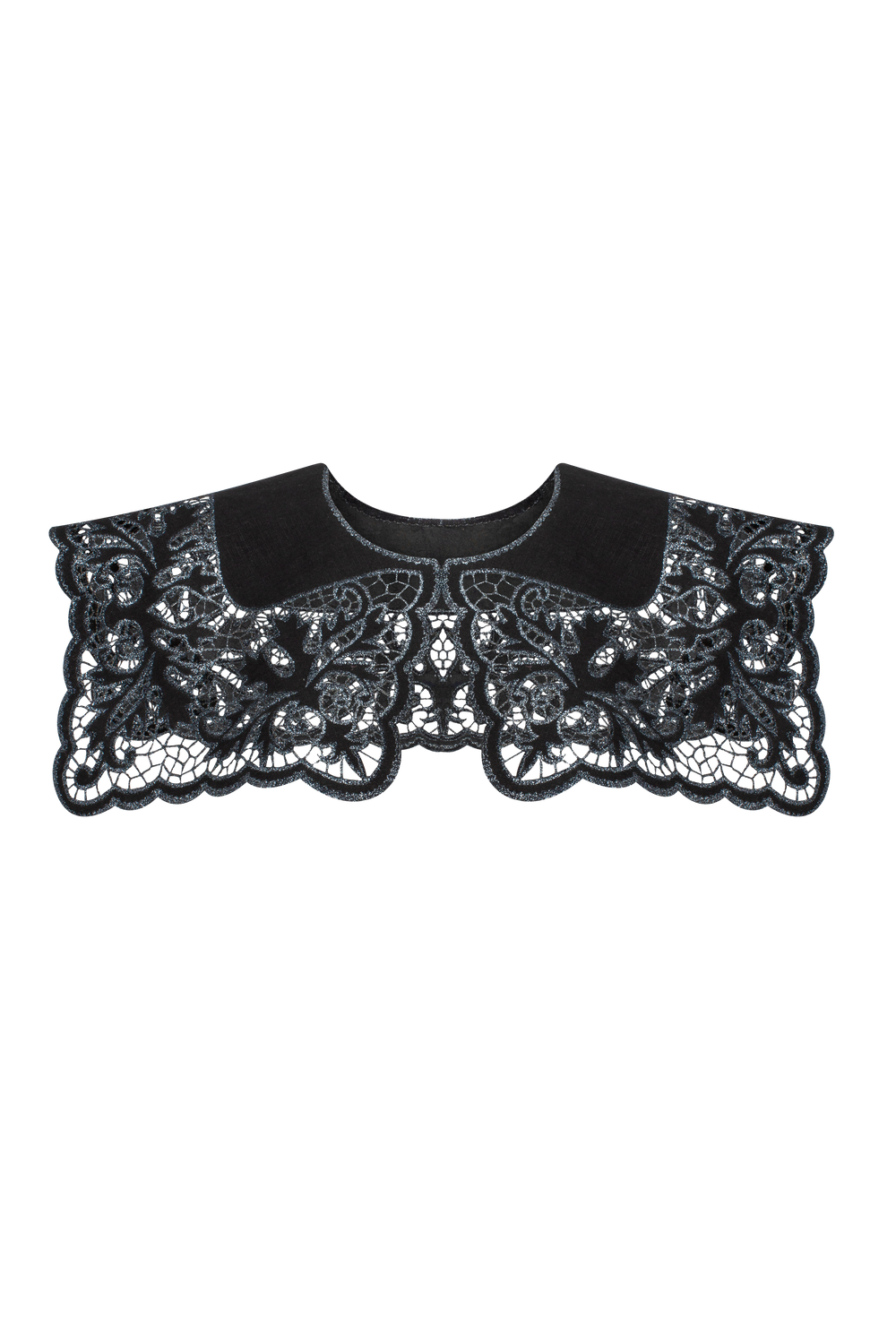
Drama, distilled. Silver embroidery glints across black linen, cut square across the shoulder to sit boldly over a dress, a blouse, or knitwear. This is evening wear reimagined as an accessory — the collar that does the work of a necklace, a brooch and a statement all at once. 100% linen · Richelieu cutwork, point lace · black with silver embroidery · Shop now →
3. Lily Richelieu Embroidered Cutwork Collar — Red Linen

For the woman who understands that red is a neutral. Red on red, in the same rounded silhouette, tonal and confident — a nod to the "red thread" that runs through both Romanian and Ukrainian folk dress. Worn over black, it is pure Matisse. 100% linen · Richelieu cutwork, point lace · red on red ·150 Euro Shop now →

Recommendations: How to Wear It, the Modern Way
The beauty of the detachable collar is its shape-shifting versatility. A few editor's notes on wearing it now, staged from easiest to most adventurous:
- Start over knitwear. The single chicest move: lay a white or pearl collar over a fine-gauge crewneck or a slouchy cashmere sweater. Instant polish, zero effort — the collar carries the entire look. This is the entry point; if you buy one collar, make it the White Lily.
- Graduate to the tonal layer. Wear a red-on-red or black-on-black collar over a matching monochrome outfit. The texture does the talking; the effect is quiet luxury at its most refined.
- Treat it as jewellery. Over a strapless dress, a simple tee, or an open blazer, the collar frames the face the way a statement necklace never could — ideal when you want impact without hardware.
- Go high-contrast. Set a crisp white cutwork collar against a black blazer or dark shirtdress for a graphic, mod-inflected line.
- For the bride. A pearl-embroidered white collar over ivory silk is a modern bride's answer to "something handmade" — heritage without the costume.
- The rule of restraint. Because the collar is the hero, keep everything else simple: sleek hair, small earrings, clean lines. Let the hand-work be the only ornament that speaks.
Practical note: because each collar is cut and stitched to order, allow one to four weeks of production time on top of shipping — plan ahead for events and gifting. If you are buying for a specific occasion, order early; the made-to-order model is precisely what guarantees the piece is truly hand-worked.
Caveats
- Made-to-order timelines. These are not off-the-shelf accessories. Production runs 1–4 weeks before dispatch, and international delivery adds further time — a feature of genuine craft, but one to factor into any deadline.
- Colour and price vary by style. Both "Lily" and "Barvy" lines exist in overlapping colourways; prices on the featured pieces range from 130 Euro to 250 Euro so confirm the exact variant and current price at checkout.
- Heritage attribution. The techniques (Richelieu cutwork, point lace) are pan-European in origin but are here executed within a living Ukrainian whitework tradition; the Romanian ie context provides the cultural frame for Blouse Roumaine Shop's curation rather than the specific provenance of these particular collars, which are ANNABO's Ukrainian craft.
- A minor date discrepancy exists in sources on when Reshetylivka "white-on-white" embroidery entered Ukraine's National Inventory (2017 per some sources, February 2018 per the official protection order); both point to the same recognition.
In an age of the disposable, the detachable embroidered collar is a small manifesto. It is made by named hands, in real linen, using techniques that took centuries to perfect and months to master. It moves from garment to garment, season to season, outlasting every trend cycle. It is, in the truest sense, a new heirloom — and at Blouse Roumaine Shop, it is waiting to be tied around your shoulders.


0 Kommentare